


Management is the process of planning, organizing, directing and controlling and the application of these principles in harnessing physical, financial, human and informational resources efficiently and effectively to achieve organizational goals.
What is Management?
In other words, Management in all business and organizational activities is the act of getting people together to accomplish desired goals and objectives using available resources efficiently and effectively.
Good management is the backbone of successful organizations. Good management of an organization makes the difference between the success and the failure of the organization.
Management, as a system, is not only an essential element of an organized society, but also an integral part of life when we talk about managing our lives. Managing life is not much different from managing an organization and this ‘art’ of management has been with us from time immemorial.
Historical Evolution and Definition of Management
The verb manage comes from the Italian maneggiare (to handle — especially tools), which in turn derives from the Latin manus (hand).
The French word mesnagement (later ménagement) influenced the development in meaning of the English word management in the 17th and 18th centuries.
Views on the definition of management by many different management people in their own words as follows:
Henri Fayol defined management as “to manage is to forecast and to plan, to organize, to command, to coordinate and to control”.
Egginson, Mosley and Pietri define management as ‘working with human, financial and physical resources to achieve organizational objectives by performing the planning, organizing, leading and controlling functions‘.
Ghislain Deslandes defines management as ”A vulnerable force, under pressure to achieve results and endowed with the triple power of constraint, imitation, and imagination, operating on subjective, interpersonal, institutional and environmental levels”.
Kreitner’s definition of management: ‘Management is a problem solving process of effectively achieving organizational objectives through the efficient use of scarce resources in a changing environment.’
The 3 Levels of Management Hierarchy
Most of the organizations have three levels of management:
| Level | Key Roles | Primary Responsibility |
| Top Level | CEO, Board of Directors | Goal Setting & Policy Making |
| Middle Level | Department Heads, Managers | Executing Plans & Coordination |
| Lower Level | Supervisors, Foremen | Operational Efficiency & Direct Supervision |
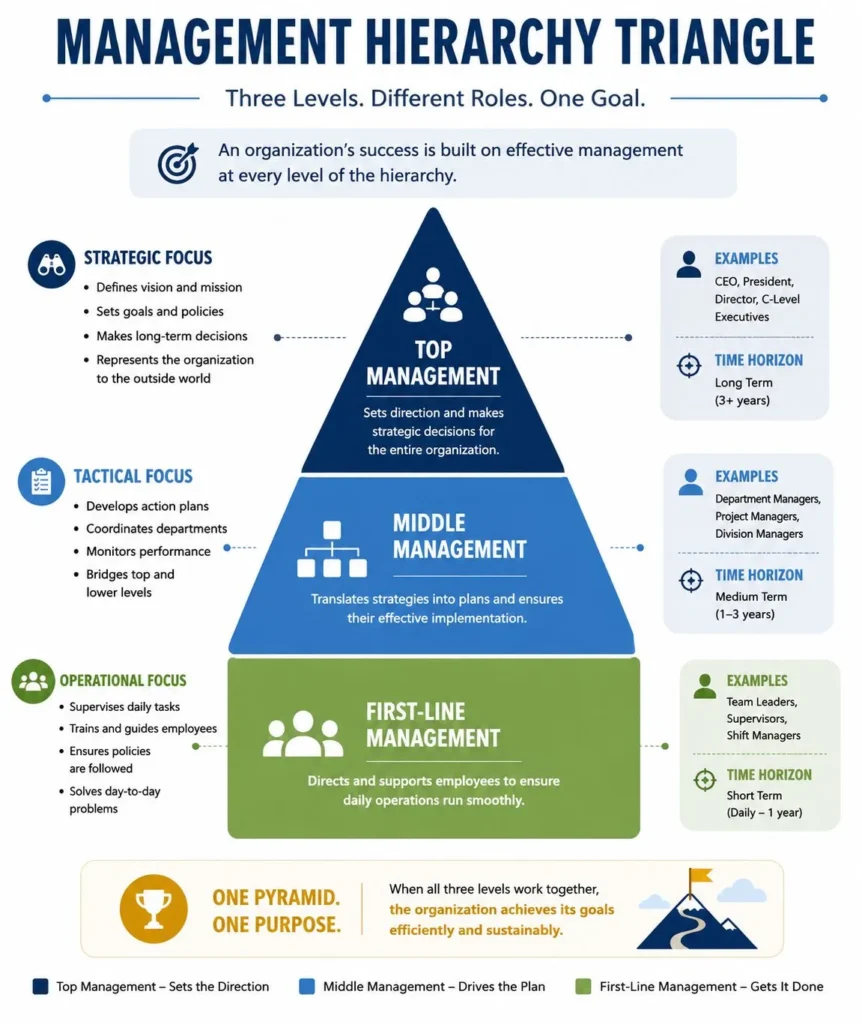
Top-Level Management:- This is the highest level in the organizational hierarchy, which includes Board of Directors and Chief Executives. They are responsible for defining the objectives, formulating plans, strategies and policies.
Middle-Level Management:- It is the second and most important level in the corporate ladder, as it creates a link between the top and lower level management. It includes departmental and division heads and managers who are responsible for implementing and controlling plans and strategies which are formulated by the top executives.
Lower Level Management:- Otherwise called as functional or operational level management. It includes first line managers, foreman, supervisors. As lower level management directly interacts with the workers, it plays a crucial role in the organization because it helps in reducing wastage and idle time of the workers, improving the quality and quantity of output.
Essential Functions of Management
There are five fundamental functions of management given by KOONTZ and O’DONNEL i.e. Planning, Organizing, Staffing, Directing and Controlling. But Luther Gullick has given a keyword ’POSDCORB’ where
- P – Planning
- O– Organizing
- S – Staffing
- D – Directing
- Co – Co-ordination
- R – Reporting
- B for Budgeting
But we discussed to main factor of function of management which are given below:-
Planning: It is the first, basic and foremost function of management. We also say that Planning is determination of courses of action to achieve desired goals.
Planning is necessary to ensure proper utilization of human & non-human resources. i.e. to decide beforehand what is to be done in future. It encompasses formulating policies, establishing targets, scheduling actions and so forth.
Organizing: Once the plans are formulated, the next step is to organize the activities and resources, as in identifying the tasks, classifying them, assigning duties to subordinates and allocating the resources.
Staffing: It is the function of manning the organization structure and keeping it manned. It involves hiring personnel for carrying out various activities of the organization. It is to ensure that the right person is appointed to the right job.
Directing: It is the task of the manager to guide, supervise, lead and motivate the subordinates, to ensure that they work in the right direction, so far as the objectives of the organization are concerned.
Controlling: The controlling function of management involves a number of steps to be taken to make sure that the performance of the employees is as per the plans.
It involves establishing performance standards and comparing them with the actual performance. In case of any variations, necessary steps are to be taken for its correction.
Management in the Age of AI
In today’s era, management is no longer just about managing people; it is about overseeing AI-Human Collaboration. AI is transforming modern management in these three key ways:
1. Data-Driven Decision Making
Previously decisions on planning were based on managers‘ experience or instinct. Nowadays we use AI tools which process millions of data in a few seconds and create perfect forecasts. that means we can say that Guesswork is now tranform to evidence based.
2. Automation of Routine Tasks
AI has revolutionized the ‘Staffing‘ and ‘Controlling’ functions of management:
- Recruitment: AI tools can shortlist the best candidates from thousands of resumes instantly.
- Performance Tracking: AI dashboards track employee productivity in real-time, making the ‘Controlling’ function far more transparent.
3. From Traditional Management to Agentic AI
In 2026, the new trend in management is Agentic AI. Managers are moving beyond software; they are now delegating the management work to an ‘AI Agent’, who are designed to be able to take decisions, solve problems independently. Consequently, the role of middle managers have change from mere ‘supervision’ to high level ‘strategy’.
Final Thoughts
Now, At last words, We can say that Management is not only determine in an organization, but Everything that we manage to improve, we can call it a management. For Example we manage to fulfill the need in our life, or we manage to fulfill its need to improve our family or society. Every thing is part of management which we learn to manage.
An MBA in Finance today is incomplete without understanding how AI algorithms manage risk and optimize resources. Management is no longer just about leadership; it’s about technological integration.






Thanks for sharing knowledge