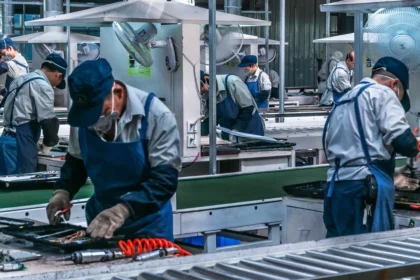


Transfer involves a change in the job (along with it change in the place of the job) without change in position, pay or responsibilities. Transfers are frequent but not promotions.
Organisation resort to another type of mobility of employees in order to place the right employee in the right job.
This type of mobility which is restricted to movement of an employee fro one job to another in the same level of organisational hierarchy is termed to transfer.
Meaning of Transfer
Transfer is a lateral shift causing movement of individuals from one position to another usually without involving any marked change in duties, responsibilities, skills needed of compensation,”
Transfer is also defined as the moving of an employee from one job to another. It may involve a promotion, demotion or no change in job status other than moving from one job to another,”
Transfer is viewed as change in assignment in which the employee moves from one job to another in the same level of hierarchy requiring similar skills involving approximately same level of responsibility, same status and the same level of pay.
Promotion is upward reassignment of a job; demotion is a downward job reassignment whereas transfer is a latter or horizontal job reassignment.
Reasons of Transfer
Organisations resort to transfers with a view to attain the following purposes:
Purpose 1: To meet the organisational requirements
Purpose 2: To satisfy the employees need
Purpose 3: To utilize employee’s skill, knowledge etc.
Purpose 4: To improve employee;s background by placing him to different jobs of various departments, units, regions etc.
Purpose 5: To correct inter-personal conflicts.
Purpose 6: to adjust the workforce of one section/plant in other section/during lay-off, closure or adverse business conditions or technological change.
Purpose 7: To give relief to the employees who are overburdened or doing complicates or risky work for a long period.
Purpose 8: To punish the employees who violate the disciplinary rules.
Purpose 9: To punish the employees who violate the disciplinary rules.
Purpose 10: To help the employees whose working hours or place of work is inconvemiemnt to them.
Purpose 11: To minimize fraud, bride etc., which result due to permanent stay and contact of an employee with customers, dealers, suppliers etc.
Type of Transfer
Transfers can be classified into the following types:-
- Production Transfer
- Replacement Transfer
- Rotation Transfer
- Shift Transfer
- Remedial Transfer
- Penal Transfer
Type 1: Production Transfer
Transfers caused due to changes in production
Type 2: Replacement Transfer
Transfer caused due to initiation or replacement of a long standing employee in the same job.
Type 3: Rotation Transfer
Transfer initiated to increase the versatility of employees.
Type 4: Shift Transfer
Transfer of an employee from one shift to another.
Type 5: Remedial Transfer
Transfer initiated to correct the wrong placements.
Type 6: Penal Transfer
Transfer initiated as a punishment for in disciplinary action of employees.
Reason for Transfer
Transfers are basically of three categories:-
- Employee Initiated Transfer
- Company Initiated Transfer
- Public Initiated Transfer
1. Employee Initiated Transfer
These transfers are also known as personal transfers. These transfers are primarily in the interest of the employee and according to his convenience and desire.
These transfers can be temporary and permanent.
Employee initiated transfer must have been following reason:-
- Due to ill health or involvement of employees in accidents.
- Due to family problems like taking care of old parents
- Due to other adhoc problems like pursuing higher education.
- With a view to correct his wrong placements.
- To avoid conflicts with his superiors.
- With a view to search for challenging and creative job.
- With a view to search for higher level job, opportunities for financial gains etc.
2. Company Initiated Transfer
Transfers are also at the initiative of the company. These transfers also can be temporary and permanent.
Mostly have below reason for Company Initiated Transfer.
- Due to temporary absenteeism of employees.
- Due to fluctuations in quality of production and thereby in work load.
- Due to short vacations.
- To improve the versatility of employees
- To improve the employee’s job satisfaction.
- To minimize bride or corruption.
- Change in the quality of production, lines of activity, technology, organisational structure as discussed earlier.
4. Public Initiated Transfer
Public also initiate the transfers generally through the politicians/government for the following reasons.
- If an employee’s behavior in the society is against the social norms or if he indulges in any social evils.
- If the functioning of an employee is against the public interest.
Some employees may be transferred frequently because of political victimization and company initiated transfers of some employees may be stopped due to political favoritism. This type transfers mostly seen in governments departments and public sector units.
Principles of Transfer
Organisation should clearly specify their policy regarding transfers otherwise superiors may transfer their subordinates arbitrarily if they do not like them.
Most of the people may ask for transfers to risk less and easy jobs and places. As such, an organisation may find it difficult to manage the transfer policy.
Systematic transfer policy should contain the following items:
Policy 1: Specification of circumstances under which an employee will be transferred in the case of company initiated transfer.
Policy 2: Specification of a superior who is authorized and responsible to initiate a transfer.
Policy 3: Jobs from and to which transfers will be made based on the job specifications, description and classification etc.
Policy 4: The region or unit of the organisation within which transfers will be administered.
Policy 5: Reason which will be considered for personal transfers, their order of priority etc.
Policy 6: Norms to decide priority when two or more employees request for transfer like priority of reason, seniority.
Policy 7: Reasons for mutual transfer of employees.
Policy 8: Specification of basis for transfer like job analysis, merit and length of service.
Policy 9: Specification of pay, allowances, benefits etc. that are to be allowed to the employee in the new job.
Policy 10: Other facilities to be extended to the transference like special leave during the period of transfer, special allowance for packaging luggage, transportation etc.
Problems of Transfers
Despite these benefits, some problems are associated with transfers. They are:
- Adjustment problems to the employee to the new job, place, environment, superiors and colleagues.
- Transfers from one place to another cause much inconvenience and cost to the employee and his family members relating to housing, education of children etc.
- Transfer from one place to another result in loss of many days.
- Company initiated transfers result in reduction in employee contribution.
- Discriminatory transfers affect employee morale, job satisfaction, commitment and contribution.
Conclusion
At last words, Transfers benefit both the employees and the organisation. Transfers reduces employees monotony, boredom etc., and increase employees job satisfaction. And they improve employees skills, knowledge etc., and they prepare to employee to meet organisational exigencies including fluctuations in business and organisational requirements.
Related Topic :-
Note :- For any quires of this article, you can comment us and For Contact with us you can like our Facebook page to and Subscribe to the YouTube channel.