



The Constitution of India begins with a Preamble. The term Preamble means an introductory statement that sets out the guiding purpose, principles and philosophy of the Indian Constitution. A preamble gives a brief introduction of documents by highlighting the principles and fundamental values of the document. It shows the source of the authority of the document.
The American Constitution was the first Constitution in the world to begin with Preamble. The Preamble of the Indian constitution is based on the ‘Objective Resolution’ moved by Jawahar lal Nehru in the Constituent Assembly which was adopted by the Constituent Assembly. It was the last piece of Drafting adopted by the Constituent Assembly at the end of the first reading of the Constitution and then placed at the beginning of the Constitution.
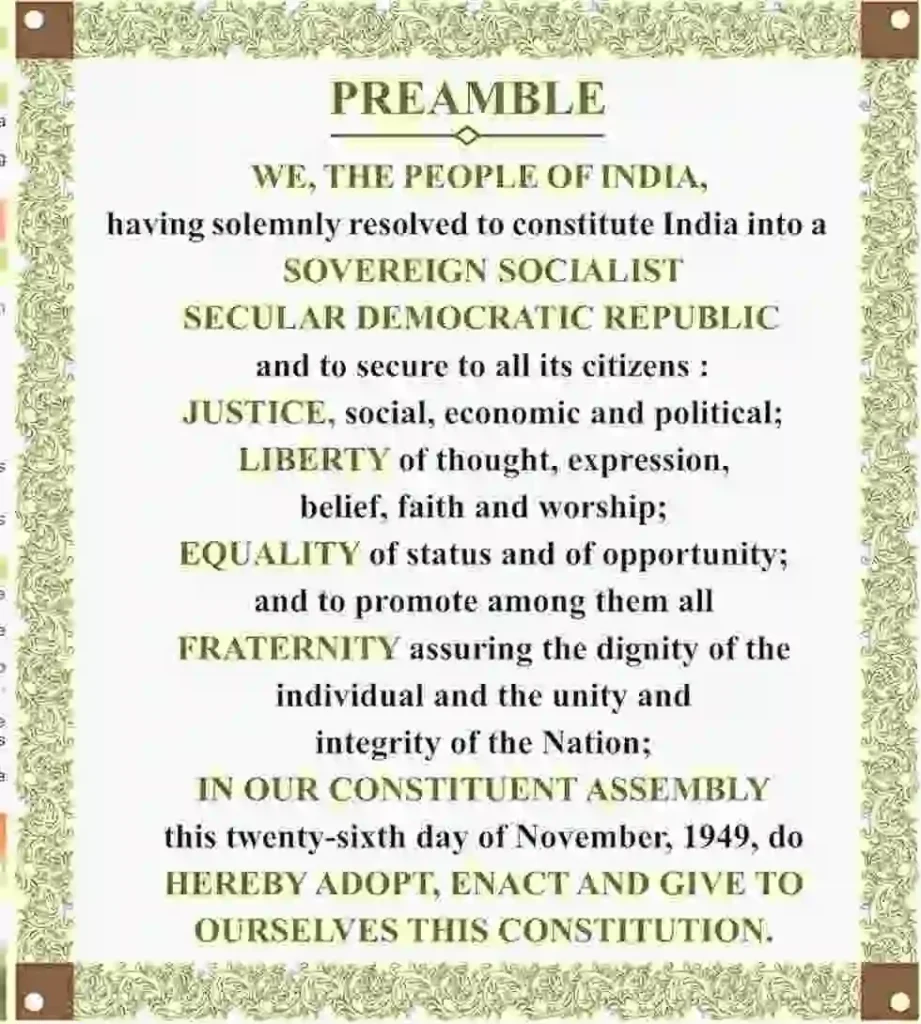
Text of The Preamble
WE, THE PEOPLE OF INDIA, having solemnly resolved to constitute India into a SOVEREIGN SOCIALIST SECULAR DEMOCRATIC REPUBLIC and to secure to all its citizens:
- JUSTICE, social, economic and political;
- LIBERTY of thought, expression, belief, faith and worship;
- EQUALITY of status and of opportunity;
And to promote among them all FRATERNITY assuring the dignity of the individual and the unity and integrity of the Nation;
IN OUR CONSTITUENT ASSEMBLY this twenty-sixth day of November, 1949, do HEREBY ADOPT, ENACT AND GIVE TO OURSELVES THIS CONSTITUTION.
Components of The Preamble
- SOURCE OF AUTHORITY: Preamble specifies that Constitution of India derives its authority from the people of India
- NATURE OF INDIAN STATE: Preamble declares India as a Sovereign, Socialist, Secular, Democratic and Republican state.
- OBJECTIVES OF THE CONSTITUTION: Preamble specifies justice, liberty, equality and fraternity as its objectives.
Ideals Mentioned in the Preamble
Sovereign
Sovereignty is one of the principle elements of any independent State. It means absolute independence, i.e., a government is not controlled by any other power, be it internal or external. The term ‘Sovereign’ mentioned in the Preamble means that India has its own independent authority and it is not a dominion of any other external power.
Socialist
The term “Socialist” added by the 42nd Amendment act 1976 in the Preamble. The word ‘Socialism’ had been used in the context of economic planning. It means commitment to attain ideals like removal of inequalities, provision to ensure minimum basic necessities to all equal pay for equal work etc.
Secular
The term ‘secular’ was also added by the 42nd Constitutional Amendment Act of 1976. That means India is neither religious, nor irreligious nor anti- religious, It implies that in India there will be no ‘State’ religion – the ‘State’ will not favour any particular religion out of public fund.
Democratic
Abraham Lincoln said that, ‘Democracy is government of the people, by the people and for the people’. The
term ‘Democratic’ implies that the Constitution of India which gets its authority from the possession of supreme power by the people expressed in an election. The democratic principles are highlighted with the provisions of universal adult franchise, elections, fundamental rights, and responsible government.
Republic
India has a republic form of government as the head of state is elected and not a hereditary monarch like a king or queen. The word ‘republic’ shows a government where the head of state is elected by the people rather than any hereditary.
Justice
Justice stands for rule of law, absence of arbitrariness and a system of equal rights, freedom and opportunities for all in a society. The Preamble covers all these dimensions of justice – social, economic and political secured through various provisions of the Fundamental and Directive Principles.
- Social justice stands for all citizens are equal without any discrimination on the grounds of race, religion, caste, sex or place.
- Economic Justice means no discrimination can be caused by people on the basis of their wealth, income, and economic status
- Political Justice means that all citizens have equal rights in political participation.
Liberty
The Preamble provides for the liberty of thought, expression, belief, faith, and worship. The Indian Constitution guarantees six democratic freedoms to the individuals under Article-19 and right to freedom of religion under Articles. 25-28. The ideals of Liberty, Equality and Fraternity are taken from French Revolution.
Equality
The term ‘equality’ means the absence of special privilege to any section of society, and the provision of adequate opportunity of all the individuals without any discrimination. Preamble ensures equality at- social,
political and economic front.
Fraternity
Fraternity as enshrined in the Constitution means a sense of brotherhood prevailing amongst all the sections of the people However, fraternity is an evolving process and by the 42nd amendment, the word ‘integrity’ was added, thus giving it a broader meaning. To ensure sense of brotherhood Indian Constitution
have provision of single citizenship.
Significance of the Preamble
As the Supreme Court has observed, the Preamble is a key to unravel the minds of the makers of the Constitution. It also embodies the ideals and aspirations of the people of India. It can neither provide substantive power (definite and real power) to the three organs of the State, nor limit their powers under the provisions of the Constitution.
Important Judgements
- Berubari Union case (1960) – Supreme Court held that Preamble is not a part of the Constitution. Preamble is in itself neither a source of any powers, nor a source of any restrictions. The preamble is an important tool for interpretation of the Constitution.
- Kesavananda Bharati vs. State of Kerala (1971) – The Supreme Court overruled berubari Union case judgement and made it clear it is not an essential part of the Constitution and parliament has to the amending power as other provisions.
- Minerva Mills V Union of India (1980) – Supreme Court held that any positive amendment in the Preamble can certainly be made. Preamble can be amended by procedure held in Article 368 of the Constitution
- S.R. Bommai case (1993) – In dismissal of three Governments in MP, Rajasthan and Himachal Pradesh, Justice Ramaswamy said, “the Preamble of the Constitution is an integral part of the Constitution
Amendment of the Preamble
The 42nd Amendment of 1976, changed the description of India from a “sovereign democratic republic” to a “sovereign, socialist secular democratic republic”, and also added the word ‘integrity’ to change, “unity of the nation” to “unity and integrity of the nation”. In this amendment, the Preamble was amended to include ‘socialist’, ‘secular’, ‘integrity,’ as it was assumed that this amendment is clarification in nature.