


While banks may appear solvent, underlying vulnerabilities such as high-risk lending-can quickly surface if liquidity dries up. A single whisper spreads trust drains like water through fingers. Lines form at counters, people moving quick, scared of losing what’s theirs. Often, poor watching and loose decisions pour fuel on fire.
By the time shouts echo down halls, control has slipped away. Unexpectedly, these events spark long downturns, ripple through nations, then linger in how people live. Rare? Sure, that feels right – but bank collapses show up way too often, as if time just can’t let go.
This article looks at banking troubles since the 1600s, digging into what sparked them, how they unfolded, why reactions differed. Starting long ago, it untangles three linked events – when banks collapse, when crowds rush to pull money out, when entire systems shake then follows their paths through shifting economies, changing rules.
Defining Financial Crises, Bank Runs, and Systemic Failures
Financial crises come in all shapes, and it helps to sort out their differences. Not every problem leads to a full meltdown- sometimes, a bank run triggers the trouble, but that’s not always how it starts. Each one-banking crises, bank runs, bank failures-stands on its own, even if they often show up together. What happens in one can light the fuse for the next, but they’re never quite the same thing.
What is a Banking Crisis?
A banking crisis hits when many banks run into trouble at once, either because they can’t pay their debts or don’t have enough cash. Suddenly, the whole financial system shakes.
Usually, these come from big asset bubbles (like real estate or stocks), banks taking on too much debt, lazy regulations and fast changes in interest rates. Here’s the core idea, trouble hits multiple banks at once, putting the whole financial setup at risk.
What is a Bank Run?
A bank run is pretty simple-a lot of people freak out and scramble to yank their money from a bank. Most banks only keep a tiny bit of deposits on hand. The rest goes into loans and other investments.
So, when too many folks demand their cash at once, even a healthy bank can’t keep up. Nowadays, digital banking and social media make this happen way faster. It’s like a slow worry flaring up into a wildfire within hours. In essence:
“A bank run happens when a crowd of depositors loses confidence and demands their money back all at once-banks with fractional reserves just can’t pay everyone at the same time.”
What is a Bank Failure?
A bank failure is what comes next when a bank can’t pay its debts or keep enough cash to run. Maybe it’s insolvent; maybe it just has zero liquidity left. Usually, regulators step in and shut things down. Sometimes, the bank gets merged, restructured, or liquidated, but the point is, it’s done. In essence:
“A bank failure means regulators close a bank because it’s broke or out of cash.”
A bank failure occurs when:
- The Bank’s debts outweighs its assets.
- It has negative capital.
- Cash dries up.
- Regulators step in and close the bank
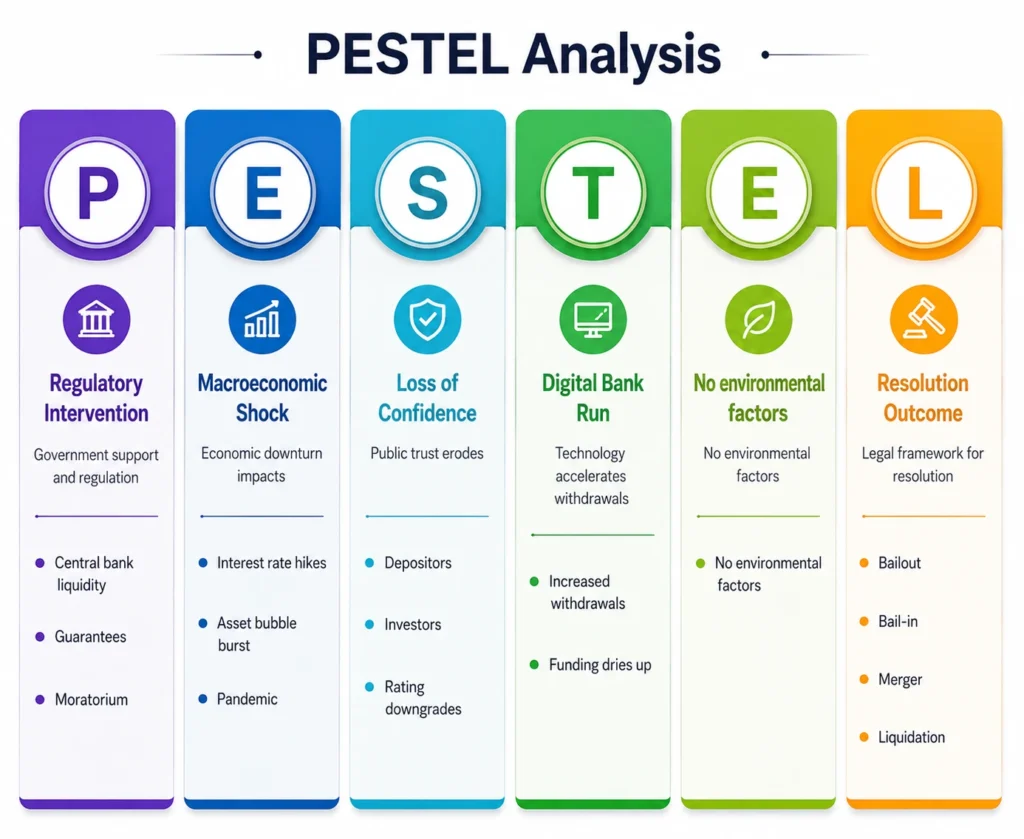
The 10-Stage Mechanics of a Banking Crisis
It doesn’t blow up all at once. One small problem grows quietly, and then the panic spreads like wildfire. Here’s the basic cycle:
| Stage | Stage Name | Description & Triggers |
| 1 | Big Shock | Abrupt interest rate hikes, the sudden bursting of asset bubbles (real estate/stocks), or unexpected global black swan events like a pandemic. |
| 2 | Asset Values Drop | Loan portfolios begin to sour as borrowers default, and the market value of bonds held by banks falls sharply. |
| 3 | Balance Sheet Weakens | Continuous credit losses lead to capital erosion, causing a significant rise in Non-Performing Assets (NPAs). |
| 4 | Confidence Fades | Sensing financial weakness, depositors and investors pull their money back; credit rating agencies downgrade the institution. |
| 5 | Liquidity Squeeze | Withdrawal demands rise exponentially while standard wholesale interbank funding channels dry up completely. |
| 6 | Bank Run | Panic spreads to the general public, resulting in mass withdrawals executed via lightning-fast digital sprints. |
| 7 | Fire Sales | To meet immediate cash demands, banks are forced to sell their long-term assets at a steep loss, further destroying their remaining capital. |
| 8 | Contagion | Panic spreads like a contagion to healthy financial institutions, causing the entire interbank lending market to freeze. |
| 9 | Regulatory Intervention | The central bank steps in as a lender of last resort to add cash liquidity, issue emergency guarantees, or declare a temporary moratorium. |
| 10 | Final Resolution | The crisis concludes with a government-backed bailout, a creditor bail-in, a forced structural merger, or liquidation. |
Causes of Banking Crises
1. Excessive Risk-Taking
Profits pull banks forward, yet risk slips their mind. When chasing returns, caution often gets left behind. Shaky loans appear, then messy outcomes tag along. Investments tilt toward danger, soon complications knock. Trouble arrives quietly, after bold moves stack up.
2. Asset-Liability Mismatch
The fundamental challenge for banks is the asset-liability mismatch: they rely on short-term deposits while committing to long-term lending. Borrowing happens now; lending stretches later. Quick receipts pair with drawn-out paybacks. Now becomes then across their balance sheets.
3. Bad Credit Quality
When lenders give money to people who can’t pay it back, problems grow slowly. Bit by bit, the weight of those losses begins pulling down the lender.
4. Economic Downturns
Borrowing gets harder when times turn tough. People start falling behind on payments once the economy shrinks. Defaults jump, and banks feel the squeeze.
5. Weak Regulation and Supervision
When eyes are off them, banks start cutting corners. Hidden behind silence, dangerous choices pile up until the moment they can’t be ignored.
6. Domino Effect (Contagion Effect)
A single bank falling apart might spark what comes next – panic moves fast, dragging more down with it.
7. Over-Leverage
A small stumble can spiral fast when debt piles up. Heavy borrowing leaves little room to recover.
8. Liquidity Shortages
Sometimes, banks just can’t get enough cash fast enough.
9. External Shocks
Besides wars, there are pandemics. Crises spread across continents too. Name any disaster; it fits the pattern. Far-off problems might just punch right into hometown lenders.
Non-Performing Assets (NPAs)
Most times, when someone stops paying back a loan for about three months, it turns into what banks call a non-performing asset. These unpaid debts show up right in the middle of financial trouble at lending institutions. Trouble builds slowly, yet surely, as profits shrink under the weight of unrecovered money.
Each delayed payment chips away at available funds meant for new lending. Behind every missed instalment lies a deeper issue trust weakens between borrower and bank. Lenders find themselves stuck holding promises that no longer hold value.
1. How NPAs Weaken Banks
- Reduced income as interest ceases to accrue on impaired loans
- Required provisioning consumes capital reserves
- Regulatory scrutiny intensifies, restricting new lending
- Investor and depositor confidence declines.
2 Notable Indian Cases
Vijay Mallya
He walked away from nearly 9,000 crore owed by Kingfisher Airlines. Loans handed out without solid assets backing them showed weak checks. Favours seemed to matter more than financial soundness when banks approved deals. Power connections played a role behind the scenes. Lending decisions leaned less on risk, more on influence.
The fallout revealed how deeply oversight had failed. Money vanished into an airline that couldn’t stay airborne. Oversight gaps stared back once the crash came. Political ties blurred where responsibility should have been clear.
Nirav Modi
Fraud unfolded quietly inside a government bank, where messages meant for secure transactions carried false promises instead. Years passed before anyone noticed the trail of fake LoUs slipping through the system. A man named Nirav Modi stood behind the scheme, using global message codes to borrow money he never repaid.
Punjab National Bank lost 13,500 crore while oversight slept. What looked like routine banking was, in truth, an elaborate deception built on trust and hidden gaps.
Yes Bank (2020)
By 2019, bad loans at Yes Bank had jumped close to 17%, up from less than 2% not long before. Because of this, the bank needed help. A fix arranged by authorities brought in State Bank of India to take charge during early 2020.
Failures like these aren’t new. What we’re seeing now shows problems deep within how lending checks happen. Oversight from regulators has also come up short. Internal audits often miss critical red flags. This isn’t a pattern limited to one country. India faces it. Others do too.
3. High NPAs affect Markets and Depositors
High NPAs do not just weaken banks internally they also affect financial markets, depositors, and the broader economy.
Impact on Stock Market
- Rising NPAs reduce bank profitability
- Investors lose confidence in bank performance
- Bank share prices fall sharply
- Market capitalization declines
- Banking sector drag pulls down broader stock indices
- Example: Yes Bank stock collapsed from 393 (2018) to below 10 during the 2020 crisis
Impact on Fixed Deposits
- Depositors may panic and withdraw funds
- Banks may reduce FD interest rates to preserve liquidity
- In extreme cases, withdrawal limits may be imposed (e.g., Yes Bank 2020)
- Depositors above insured limits face risk
- However: Deposit insurance (5 lakh in India) protects small depositors
Impact on Savings Account Holders
- Reduced interest rates
- Withdrawal restrictions (in extreme cases)
- Increased uncertainty and panic
Impact on Bond Holders
- Bank bond prices fall
- AT1 bonds may be written off (Example: Yes Bank AT1 write-off in 2020)
- Institutional investors face losses
Impact on Credit Availability
- Banks become cautious
- Lending slows down
- Economic growth weakens
Systemic Impact
- Loss of confidence spreads
- Risk of bank runs increases
- Domino effect begins
Deposit Protection and Warning signs for Depositors
Deposit Insurance Systems
Most people feel safer when their money is protected. Because deposits are covered, fewer rush to pull cash at the first sign of trouble. Around the world, similar systems exist where savings up to a limit get shielded. Key examples globally include:
| Scheme | Country/Region | Coverage |
| DICGC | India | 5 lakh per depositor per bank (savings, fixed, current accounts) |
| FDIC | United States | $250,000 per depositor per institution; established 1933 |
| EU DGS Directive | European Union | €100,000 per depositor per institution across member states |
Important limitation: amounts above insured thresholds carry unprotected risk if a bank fails. SVB’s collapse in 2023 exposed this starkly approximately 90% of its deposits were uninsured, creating acute systemic risk.
Red Flags for Depositors
Depositors and investors can monitor the following warning indicators:
- Unusually high interest rates offered on deposits.
- Rising Non-Performing Asset (NPA) ratios disclosed in financial statements
- Sudden restrictions on withdrawals.
- Frequent changes in senior management.
- Regulatory warnings, corrective action orders, or credit rating downgrades
- Heavy reliance on wholesale funding rather than stable retail deposits
- Outsized concentration in a single sector.
How Do Watchdog Groups Stop Bank Collapses?
Regulators are the safety net. They constantly check on banks, enforce strict rules, and act fast when things seem risky. During a crisis, they shift from quietly monitoring to outright damage control.
1. Evolution of Basel Standards
The Basel Accords, developed by the Bank for International Settlements, represent the most significant international framework for bank regulation:
- Basel I (1988): Established minimum capital requirements of 8% of risk-weighted assets, focusing on credit risk.
- Basel II (2004): Refined risk weighting, introduced operational and market risk capital charges, and incorporated supervisory review and market discipline pillars.
- Basel III (2010-13, post-GFC): Introduced higher and better-quality capital requirements, leverage ratios, liquidity coverage ratios (LCR), and net stable funding ratios (NSFR) to address the weaknesses exposed by the Global Financial Crisis.
2. Prudential Regulation
Set rules for capital and liquidity. Basel standards push banks to maintain capital buffers and liquidity coverage ratios. norms push banks to keep capital cushions and liquidity coverage ratios.
3. Supervision and Monitoring
Keep an eye on risks, asset quality and leverage, both through paperwork and on-site checks. Monitoring keeps an eye on risk, asset quality, and leverage-both through paperwork and on-site checks.
4. Early Intervention
A bank appears weak, it limits lending, cuts dividends or changes management. looks shaky, they limit loans, cut dividends, or swap out management.
5. Lender of Last Resort
Central banks lend cash to banks in difficulty so that they do not run out of money. Resort central banks lend cash to banks in trouble so they don’t run out of money.
6. Deposit Insurance
Groups like the FDI depositories help prevent runs and maintain public trust. Insurance groups like the FDIC guarantee deposits, help prevent runs, and keep public trust steady.
7. Crisis Resolution Frameworks
In the event of a disaster, tools such as bailouts, internal bailouts and mergers help prevent the situation from spiraling completely out of control. Frame works if disaster strikes, tools like bailouts, bail-ins, and mergers help keep things from spiraling totally out of control.
Rules and oversight aren’t just paperwork; they keep money flowing safely and stop total chaos before it starts aren’t just paperwork- they’re what keeps money moving safely, and stops total chaos before it starts.
The Domino Effect: How Banking Crisis Spreads
A domino effect in a banking crisis means failure of one bank spreads to others, eventually affecting the entire financial system and economy. Falling dominoes show how fast trouble moves when trust fades in tightly linked banks. Let’s break it down step-by-step:
1. Interbank Lending (First Domino)
Banks lend money to each other daily to manage short-term liquidity.
Example: Bank A has excess cash → Bank B lends to Bank C → Bank C lends to Bank D. This creates a chain of dependency.
What Happens During Crisis
If Bank A fails:
- Bank B cannot repay loans,
- Bank C becomes worried,
- Bank D stops lending.
This causes liquidity freeze across banks.
Example: Banks froze loans between themselves when the 2008 crisis hit. Fear of one another collapsing took hold slowly at first, then fast. Trust vanished almost overnight once doubts began spreading. One lender’s weakness made others hesitate before dealing.
A chain reaction built up without warning. What started as caution turned into full withdrawal. Lending dried up while institutions waited it out. Nobody wanted to be left holding losses alone. This is called Interbank Market Freeze
2. Depositor Panic (Second Domino)
Fear takes hold when word gets out a bank might fail. People rush to pull their money fast. They think:
- “Is my bank safe?”
- “Should I withdraw money?”
People start withdrawing funds from multiple banks not just the failed one. This creates:
- Bank runs
- Liquidity shortage
- Multiple bank stress
Example: When Silicon Valley Bank falls in 2023, Depositors withdrew from other regional banks, and panic spread quickly across the U.S.
3. Stock Market Crash (Third Domino)
When banks show signs of weakness:
- Bank stocks fall
- Financial sector declines
- Investors panic
- Market volatility increases
This affects: Pension funds, Mutual funds, Institutional investors.
Example: When Lehman Brothers collapsed: Global stock markets plunged, Financial stocks crashed worldwide. This worsens confidence and accelerates crisis.
4. Credit Freeze (Fourth Domino)
Banks become extremely cautious during crisis. They stop Business loans, Housing loans, Corporate lending, Trade finance. This leads to Business slowdown, Job losses, Economic contraction.
Example: During the COVID-19 recession: Banks tightened lending, Businesses struggled to access credit. This is called; Credit Crunch
5 Global Contagion (Final Domino)
Modern banking is globally interconnected. So, when crisis starts in one country:
- Foreign investors pull money out
- Currency weakens
- Bond markets fall
- Other countries face stress
Example: The 2023 crisis spread quickly: Silicon Valley Bank failed (USA), Signature Bank failed (USA), Credit Suisse collapsed (Switzerland) and merged with UBS. This shows how banking crises now spread globally within days.
Complete Domino Chain
Bank Failure → Interbank Lending Stops → Depositor Panic → Stock Market Crash → Credit Freeze → Global Contagion → Economic Recession.
Why Domino Effect is So Dangerous
Because banking relies on confidence. Once confidence breaks:
- Panic spreads faster than facts
- Liquidity disappears quickly
- Governments must intervene
The Historical Timeline: Major Banking Crises Since the 1600s
Banks have struggled since the earliest days (17th – 19th Century) of money. Most of these crises arrived almost as soon as people started storing and lending cash
The 17th Century: First Experiments and Failures
Peace of Prague (Nuremberg)
Date: May 30, 1635
Government Under Reign: Holy Roman Empire under Ferdinand II;
Reason for Crisis: The crisis occurred during the war between 1618 to 1648 with severely weakened European economies, when the authorities resorted to heavy borrowings and depositors lost confidence in banks.
Outcome: The bank collapsed under financial pressure, payments resumed slowly and financial stability returned gradually and it happened to be earliest government interventions to fuse the banking crisis.
Stockholm Banco Crisis
Year: 1664
Government Under Reign: King Charles XI of Sweden
Reason for Crisis: Stockholm Banco became the first European bank to issue paper banknotes in 1661 but without sufficient reserves and then rapid and excessive lending weakened the bank’s financial position, depositors lost confidence and began demanding redemption of notes.
Outcome: Stockholm Banco collapsed in 1664 and Johan Pamlstruch was imprisoned. The bank was reorganised in 1668 and later became the Swedish Riks Bank that led to the early development of Central Banking Regulation.
Middelburg Bank Crisis:
Year: 1672 (Dutch “Rampjaar” – Year of Disaster)
Government Under Reign: Dutch Republic under Grand Pensionary Johan de Witt (until 1672) and later William III of Orange
Reason for Crisis: France, England and the German states invade the Netherlands that caused panic across financial markets and depositors rushed to withdraw money from the banks.
Outcome: Middelburg Bank stopped making payments. Banking panic spread however, the Bank of Amsterdam survived and maintained credibility.
The 18th & 19th Centuries: The Age of Panics
Bank of Scotland
Year: 1704
Government Under Reign: King William III (until 1702) and Queen Anne (1702-1714), Kingdom of Scotland
Reason for Crisis: The crisis was linked to the failure of the Darien Scheme 1698-1700, Scotland’s attempt to establish a colony in Panama. The scheme collapsed and caused massive financial losses in Scotland.
Outcome: Bank of Scotland temporarily suspended Payments and authorities intervened after that banking operations resumed in 1705. Public confidence gradually returned.
The Panic of 1819 (USA)
Year: 1819-1821
Government Under Reign: President James Monroe (1817-1825)
Reason for Crisis: When farm values dropped following the war, lending surged without caution. As crops brought less money, debt payments collapsed. Then lenders crumbled under unpaid promises. Not long after, financial trust evaporated into thin air.
Outcome: Banks collapsed across regions. Joblessness spread fast because of economic collapse. Farms lost ownership when loans defaulted. Business after business closed its doors. It happened to be first major nationwide financial crisis in U. S history.
Overend, Gurney and Company
Date: May 10, 1866
Government Under Reign: Prime Minister Lord Russell Monarch: Queen Victoria
Reason for Crisis: Overend, Gurney heavily invested in risky railway securities. The firm requested support from the Bank of England, who refused assistance.
Outcome: Panic spread fast when banks started failing called Black Friday, it happened in 1866. Suddenly, the Bank of England moved in as markets began to stumble, altering the way central banks act when trouble hits. That single event set off a chain reaction, quietly redefining how financial meltdowns are managed over time.
The Panic of 1873
Date: Sep 18, 1873 (1873-1879)
Government Under Reign: United States President: Ulysses S. Grant
Reason for Crisis:
- Collapse of railroad investments
- European stock market crash (Vienna, 1873)
- Collapse of Jay Cooke & Company
- Over-speculation and credit expansion
- Coinage Act of 1873 reducing silver money supply.
Outcome:
- Over 100 banks failed in the U. S.
- Global economic depression known as The Long Depression
- Unemployment increased, Railroad construction halted,
- Financial reforms and monetary debates followed.
The 20th Century: Volatility Reform and Systematic Change
The Showa Financial Crisis (Japan)
Date: March 14, 1927.
Government under Reign: Prime Prime Minister Wakatsuki Reijirō.
Reasons for crisis: Redemption plans for low-cost bonds tied to post-Great Kantō quake financing sparked it. A move by Japan’s central bank set the shift in motion.
Outcome: The crisis led to the resignation of Prime Minister Wakatsuki.
The Great Depression Banking Crisis
Date: Nov 1930 (1930-1933, USA)
Government under Reign: Herbert Hoover sat in the White House before a new face took over. Then came Franklin D. Roosevelt, stepping into office as things shifted. One era faded just as another began unfolding.
Reasons for crisis: Panic moved quickly once the market crashed in 1929, since countless banks were already deep in reckless bets.
Detailed Impact: Banks began collapsing one after another when people pulled their savings. Cash vanished faster than tellers could track it. A wave of fear moved through towns, pushing queues into bank lobbies every morning.
Government Actions
A national pause on banking began when President Franklin D. Roosevelt stepped in during early March of 1933. With fear spreading fast, he acted to freeze all financial activity just days after taking office.
Lawmakers moved swiftly, passing new rules by March ninth to sort out which banks could survive. Those deemed stable were allowed to open again under close watch. Later that year, a major reform took shape through legislation bearing two names Glass and Steagall.
This law brought about a safety net for ordinary savers via government-backed guarantees. At first, deposits were covered only up to twenty-five hundred dollars. Yet within months, the limit doubled, reaching five thousand by the following spring.
Table 1: Bank Failures During the Great Depression
| Year | Number of Bank Failures |
| 1929 | 650 |
| 1930 | 1,350 |
| 1931 | 2,300 |
| 1932 | 1,400 |
| 1933 | 4,000 |
The Asian Financial Crisis
Date: July 02, 1997
Regions: Thailand, Indonesia, South Korea, Malaysia, Philippines.
Government under Reign: PM Chavalit Yongchaiyudh (Thailand), President Suharto (Indonesia), President Kim Young-sam (South Korea).
Reasons for crisis: Some countries tie their money to the US dollar. When that happens, they often borrow heavily from abroad instead.
Crisis Trigger: A sudden drop in the Baht’s value hit Thailand that July, setting off tremors through neighbouring economies. Markets wobbled as confidence slipped away like sand.
Government Actions: A sum of 36 billion dollars came through from the IMF, tied to tough changes in bank rules, higher borrowing costs. One year after the turmoil began, Indonesia saw its economy shrink almost 13 percent.
Not far behind, Thailand’s output dropped more than 10 percent during same period. South Korea followed with a fall close to 6 percent. Sharp drops in currency value helped fuel these losses.
Data: Thai Baht Devaluation (Baht per USD)
Russian Debt Moratorium:
Date: August 17, 1998
Government Under Reign: Boris Yeltsin held power when the government operated beneath his rule.
Reason for Crisis:
Reason 1: When oil prices fell, Russia struggled because its budget leaned too much on energy sales. Money coming in shrank fast once global demand dipped unexpectedly.
Reason 2: Began with turmoil across Asia – money rushed out as trust faded. When currencies wobbled in 1997, investors pulled funds fast. Russia felt the hit soon after, caught in the ripple. Markets shrank there too once foreign cash vanished. Fear spread without warning, shifting flows worldwide.
Reason 3: Too much borrowing over short periods marked Russia’s financial position. Its reliance on GKOs brief government loans grew heavy. Rolling them over became harder each time. Pressure built as repayments loomed too close together.
Reason 4: Too much spending over time made debts pile up. Money owed kept growing because income never matched expenses. Each year gaps appeared between what was earned and spent. These shortfalls added up fast. Little effort went toward balancing accounts. Debt climbed higher without checks. Pressure built slowly but surely.
Outcome
1. Payments stopped when Russia failed to meet its own debt obligations. A pause on what it owed overseas followed soon after that move.
2. When the rouble dropped fast, prices shot up. Savings vanished overnight for countless people across Russia because the currency lost much of its value.
3. When the economy shrank sharply, businesses across Russia began collapsing. Job losses spread quickly through cities and towns. Factories closed without warning. Many families struggled to cover basic needs. Hardship became common in both urban centres and rural areas.
4. When fear spread worldwide, financial chaos followed. LTCM felt the heat fast this big hedge fund wobbled hard when trouble hit. Instead of holding steady, it gave way completely under pressure. Markets everywhere reacted sharply, shaken by sudden losses piling up
The 21st Century: The Global Financial Crisis and Aftermath
9/11 Impact on Markets
Date: September 11, 2001
Government Under Reign: George W. Bush – President
Reason for Crisis:
Reason 1: Unannounced, planes struck both the Twin Towers in New York and the Pentagon near Washington. That day, fear spread fast across cities, homes, streets – everyone felt it. Moments like those don’t just fade they shift something deep inside a nation.
Reason 1: Markets shut down. Not seen since 1933, New York and Nasdaq went dark for a stretch trading sputtered, settlements stalled. A rare halt froze everything in place.
Reason 1: Fear took hold. What came next felt unclear after the strikes. Safety at home seemed shaky now because of what happened.
Outcome:
1. Back open after the attacks, shares dropped hard. That Monday in September saw the Dow sink more than 684 points – about seven percent – in just one session. A sharp fall began right at the start.
2. A shaky economy got worse after the attacks. Airlines felt it first, then travel businesses saw drops too. Insurance firms faced growing pressure at the same time.
3. Fed slashes rates fast when cash dries up. Sudden drops aim to keep money moving. Pressure builds rates tumble to calm nerves. As fear spreads, lower costs for borrowing appear. Quick moves try stopping a freeze. Money flows easier after cuts hit. Stability returns once lending picks up. Panic fades if credit stays loose.
Argentina’s “Corralito”
Date: Dec 03, 2001
Government under Reign: After President Fernando de la Rúa came Eduardo Duhalde, stepping into office next.
Reasons for crisis: From 1998 on, things got worse slowly, yet the fixed exchange rate began slipping. Then came harder times as the tied currency weakened.
Detailed Crisis: Abruptly, limits hit bank withdrawals when officials tried blocking money exits. Trust crumbled fast after that move.
Government Actions: Unexpectedly, Argentina ditched its fixed exchange rate, swapping dollar-backed stability for local currency control. Trust in financial promises cracked as rules shifted without warning. Savings lost value not through risk but by policy.
Northern Rock (United Kingdom)
Date: Sep 14, 2007
Government under Reign: Prime Minister Gordon Brown and Chancellor Alistair Darling.
Reasons for crisis: A shaky way to fund operations. Just under a quarter of what it owed came from regular customer accounts; most depended on brief loans from financial markets instead.
Detailed Crisis: A queue stretched down the street – this hadn’t happened at a British high-street bank since the 1800s.
Government Actions: At first, the government promised to protect every deposit already held and any new ones too, just to halt the panic but later took control of the bank by force in February 2008.
2007 U.S. Subprime Debt Crisis
Date: 2007-2008
Government Under Reign: George W. Bush – President
Reason for Crisis:
- Some home loans went to people who had trouble paying bills before.
- Abruptly, home prices across America shot up fast.
- Without strong rules, lenders took advantage of borrowers while hiding how risky the financial setup really was.
- When rates climbed higher, some home loans got too expensive for risky borrowers.
Outcome:
- When home values plummet, families often face forced property takeovers.
- When banks lost big on mortgage-backed securities, trouble started.
- Lending dried up when banks stopped trusting one another.
- Banks everywhere felt the shock as trouble in one region jumped to others without delay.
- Bailouts kept banks from falling apart overnight.
The Global Financial Crisis
Date: Sep 15, 2008
Government under Reign: George W. Bush led the United States before Barack Obama took office. Across the Atlantic, Gordon Brown served as Britain’s prime minister at roughly the same time. Each held power during a period of global upheaval.
Reasons for crisis: Banks handed out shaky mortgages like candy before the market tumbled. Once houses lost value, those deals began collapsing one by one. That spread fast because of tangled financial tools such as CDOs.
Major Failures:
Bear Stearns collapsed in March 2008 after investors rushed to pull out. Instead of failing outright, it wound up under JPMorgan Chase through a rescue backed by officials.
A bank called IndyMac collapsed in July of 2008. A letter from a senator raised doubts about whether it could survive. That doubt sparked withdrawals totaling $1.3 billion. Regulators stepped in and took control shortly afterward.
A shockwave rippled through markets when Lehman Brothers collapsed on September 15, 2008. Once ranked fourth among U.S. investment banks, its sudden fall lit a fuse across financial systems worldwide. Credit lanes slammed shut soon after, as trust evaporated overnight between institutions.
On September 25, 2008, Washington Mutual collapsed its doors closed following a rush of withdrawals totalling $16.7 billion within ten days. That sudden drain pushed it into becoming the biggest thrift failure ever seen across America.
Government Actions:
Bailout cash hit 700 billion dollars when the U.S. stepped in through TARP. Rates dropped sharply soon after. Money flowed differently once Quantitative Easing started.
That downturn hit hard on a big scale. The International Monetary Fund says world output dipped about 0.1% in 2009 something not seen globally since wartime years. Richer nations saw steeper falls, their production down close to 3.4%. Trade worldwide? Down more than 10%. Joblessness climbed fast in large countries, adding pressure to already shaky money systems.
Iceland’s Banking Collapse
Date: Sep 29, 2008
Government under Reign: Leading the nation was Geir H. Haarde, serving as prime minister during a pivotal stretch of Iceland’s story.
Reasons for crisis: Back then, banks grew so large their total size hit ten times what Iceland’s economy produced. That scale meant the country could not possibly cover any collapse.
Government Actions: Out of the wreckage, Iceland carved up its collapsed banks locals stayed under public care, foreigners took the hit. Money moving out got restricted, just until things settled. Next came an agreement with the IMF, moving slowly through each stage.
European Sovereign Debt Crisis (2010-2012)
Out of the financial chaos came a fresh wave of trouble for Europe. As nations faltered under debt loads, help poured in – but only with harsh strings attached. Spending tightened overnight. Slumps dug in fast. Greece became the sharp edge of collapse leaders rushed, changes struck hard, trust across borders cracked wide open.
Ireland Banking and Sovereign Debt Crisis
Date: Sep 29,2008 (2008-2010)
Government Under Reign: Prime Minister: Brian Cowen
Reason for Crisis:
- Property market bubble collapse
- Bank failures (Anglo Irish Bank and others)
- Rapid increase in public debt
- Banking sector collapse
Outcome:
- Ireland received €85 billion bailout (2010)
- Banking sector restructuring
- Austerity measures implemented
- Gradual economic recovery after 2013 After the downturn, Ireland bounced back quicker than most across Europe.
Greece Sovereign Debt Crisis
Date: Apr 23, 2010 (2010-2012)
Government Under Reign: a. George Papandreou Prime Minister, b. Later: Lucas Papademos
Reason for Crisis:
Reason 1: Excessive government borrowing. A big gap between government spending and income showed up that year. More than one seventh of the country’s total economic output was missed. The numbers pointed to serious imbalance. Fifteen percent felt heavy on resources. That much came from official records in 2009.
Reason 2: Money owed that stays out of view. Reports showing numbers wrong on purpose. Weak tax collection system
Reason 3: High government spending. Loss of investor confidence
Reason 4: Rising borrowing costs
Outcome:
- Greece received €110 billion bailout (2010)
- Second bailout of €130 billion (2012)
- Hard times arrived when strict money rules were put in place.
- Massive unemployment (above 27%)
Social unrest & protests across Greece.
Date: Apr 07, 2011 (2010-2011)
Government Under Reign: Prime Minister José Sócrates
Reason for Crisis:
- Weak economic growth. High government debt
- Higher interest eats into wallets. Banks sit on shaky debt loads
- Loss of investor confidence
Outcome:
- Portugal received €78 billion bailout (2011)
- Austerity measures introduced
- Economic contraction
Gradual recovery after reforms
Date: Nov 09, 2011 (2011-2012)
Government Under Reign: Prime Minister: Silvio Berlusconi, Later replaced by: Mario Monti
Reason for Crisis:
- High public debt (over 120% of GDP)
- Weak economic growth
- Rising bond yields
- Political instability
Outcome:
- No formal bailout but strong reforms implemented
- Austerity measures introduced.
ECB intervention stabilized markets
Date: June 09, 2012 (2011-2012)
Government Under Reign: Prime Prime Minister Mariano Rajoy
Reason for Crisis:
- Housing bubble collapse
- Banking sector exposure to real estate loans
- High unemployment (above 25%)
- Weak economic growth
Outcome:
- Spain received €100 billion bank bailout (2012)
- Banking sector restructuring
- Economic slowdown
- From roughly 2014 onward, things started picking up again.
Recent Crises: Digital Speed and Sovereign Risk
Cyprus Crisis
Date: Mar 16, 2013
Government under Reign: President Nicos Anastasiades.
Reasons for crisis: Caught deep in Greece’s financial collapse, their safeguards failed. When the numbers cracked, oversight vanished like smoke.
Government Actions: That time, a major shift happened when uninsured savers – people holding more than €100,000 had to absorb cuts so banks could rebuild capital; never before had such an approach been used across the Eurozone.
Yes Bank (India)
Date: Mar 05, 2020
Government under Reign: Prime Minister Narendra Modi.
Reasons for crisis: Falling apart at the seams because oversight broke down, money troubles deepened slowly but surely, yet funds vanished when risky bets went sour.
Government Actions: A sudden move by the Reserve Bank of India brought a halt on withdrawals while pushing through a revival plan. At its core stood the State Bank of India, stepping in with fresh capital. That injection helped steady operations just when pressure was peaking.
Well past its peak, by 2019 things at Yes Bank were clearly unravelling – bad loans made up nearly 17% of lending, a steep climb from under 2% before. When core capital dropped, confidence began to fade quickly. As safety margins narrowed, worries about solvency started spreading. Each quarter brought more unease, shaking trust among depositors and fellow institutions. The shrinking financial buffer made it harder to stay steady.
Silicon Valley Bank (SVB)
Date: March 10, 2023
Government under Reign: President Joe Biden.
Reasons for crisis: When interest rates climbed, big tech depositors dominated the pool. Uninsured funds made up a large portion of the bank’s holdings. Long-term government bonds lost serious value on paper. Rising yields exposed those hidden gaps. A narrow circle of depositors added pressure from the start.
Detailed Crisis: A sudden wave of fear spread online, triggering massive withdrawals. One day alone saw SVB lose 42billion dollars. Digital access made it fast, panic on social platforms pushed it further.
Government Actions: The U.S. Treasury, Fed, and FDIC invoked a “systemic risk exception” to guarantee all deposits at SVB and Signature Bank, even those above the $250,000 limit, to prevent nationwide contagion.
Most of its deposits lacked insurance coverage – nearly nine times more than usual across banks. What made things worse, rising interest rates caused deep paper losses on lengthy government bond holdings. A rush began when customers pulled out $42 billion in just twenty-four hours. That sudden exit revealed how fast panic can spread online.
- SVB Stock Collapse Timeline $106
Signature Bank Collapse (Simultaneous Failure)
Date: March 12, 2023
Government Under Reign: President: Joe Biden
Reasons for Crisis:
- Panic following SVB collapse Closed
- Large exposure to cryptocurrency businesses
- High uninsured deposits
- Rapid withdrawal requests
- Loss of depositor confidence
- Third-largest bank failure in U.S. history
Outcome:
- Signature Bank shut down on March 12, 2023
- Deposits transferred to a bridge bank
- Contagion risk increased across regional banks
Credit Suisse Crisis and Forced UBS Merger
Date: March 15-19, 2023
Government Under Reign: President: Alain Berset
Reasons for Crisis:
- Long-standing governance failures
- Series of scandals and losses
- Exposure to failed firms (Archegos & Greensill)
- Loss of investor confidence
- Depositor withdrawals intensified after SVB collapse
- Sharp decline in stock price
Outcome:
- UBS steps in during emergency on March 19, 2023
- Swiss government backed deal worth $3.2 billion
- Central bank liquidity support provided
- One of Europe’s most historic banking rescues
Government Actions (Global Response)
- Federal officials stepped in to secure every dollar held at SVB along with funds parked at Signature Bank. Protection rolled out immediately after both institutions ran into trouble.
- Federal Reserve launched Bank Term Funding Program (BTFP)
- Swiss authorities engineered Credit Suisse-UBS merger
- Central banks coordinated liquidity support globally.
Quantitative Impact of Major Banking Crises
Great Depression (1930s): Formerly, during the 1930s, close to 9,000 American banks shut down. Meanwhile, the nation’s economic output dropped around 30 percent.
Asian Financial Crisis (1997–98): Previously, during the late nineties slump across Asia, certain countries saw their economies drop sharply losses hit thirteen percent in a few places.
Global Financial Crisis (2008): When the financial meltdown hit in 2008, worldwide trade dropped more than ten percent. That same year, output in wealthy nations shrank by 3.4%. Out of nowhere, shipping routes emptied and factory orders vanished.
European Sovereign Debt crisis: Five European Union members are in crisis. Greece unemployment increased above 27%.
SVB Crisis (2023): A huge bank called SVB lost 42 billion dollars in just one day during 2023. Most of that money – nearly all of it wasn’t protected by insurance.
Global Events Affect Banks (e.g., COVID-19)
Unawares, crises put financial systems on edge. As the pandemic spread, companies closed their doors, workers found themselves without pay checks, while missed repayments climbed fast.
Fearing the worst, customers lined up at ATMs, draining available funds inside banks. Prices flipped unpredictably, wiping out worth across investments held by lenders. Officials reacted quickly – interests dropped overnight, repayment deadlines froze, emergency money flowed into circulation.
Abruptly, lockdowns pushed people into apps they’d never used before. Banking shifted overnight when branches closed and screens lit up across homes. A sudden rush made old systems wobble under pressure.
Yet within that stress came changes long avoided. Weak spots showed up fast – but so did new ways forward. Pressure forced movement where hesitation once ruled.
Common Patterns
If you look at banking crises over time, some causes just keep coming back. Asset bubbles pop up again and again, usually in housing or the stock market. Sudden jumps in interest rates can quickly make banks’ assets worth a lot less.
When liquidity vanishes, banks struggle to swap assets for cash quickly, leaving them unable to cover withdrawals. Oversight gaps hand banks freedom freedom that leads some down a path of dangerous risks and bloated borrowing.
The Contagion Effect is another classic feature. Panics often kick off with rumors, and fear ripples through the system. One bank falling apart shakes confidence far beyond its doors. When that happens, panic spreads quickly – no matter if others are strong.
Financial instability often exhibits a contagion effect, where distress in one institution rapidly undermines confidence across the broader system A single wobble can echo through distant accounts and nations alike.
What looks stable today may feel shaky tomorrow just because of who owns what. Speed matters more than size once fear begins to move. Trust fades faster than facts travel. Connected systems carry risk quietly until someone stumbles. That stumble echoes loudly when nerves are already raw.
Faster now, digital dangers shaped by artificial intelligence keep showing up in fresh ways, pushing emergencies to spread at speed. Unexpected twists in tech mean break downs hit sooner than expected.
Comparative Policy Responses
Let’s look at how different governments have tackled banking crises:
| Case | Government in Office | Immediate State Action | Primary Resolution Method |
| U.S. 1933 | F.D. Roosevelt | Bank Holiday; Emergency Banking Act | Licensing framework & FDIC creation |
| Argentina 2001 | Fernando de la Rúa | Corralito (Deposit Freeze) | Administrative restructuring Default |
| Northern Rock 2007 | Gordon Brown | Full Deposit Guarantee | Nationalization |
| Ireland 2008 | Brian Cowen | Blanket Guarantee of Liabilities | Public Recapitalisation/ EU-IMF Program |
| Iceland 2008 | Geir H. Haarde | Capital Controls | Domestic/Foreign split; ring-fencing |
| Cyprus 2013 | Nicos Anastasiades | Temporary restrictions | Uninsured depositor bail-in |
| Yes Bank 2020 | Narendra Modi | Short Moratorium | Controlled reconstruction via SBI |
| SVB 2023 | Joe Biden | Systemic Risk Exception | All depositors protected; Fed liquidity |
Banking Crises Influenced by New Patterns
Faster shifts in banking bring fresh dangers – though a few benefits tag along. Not every change feels safe at first glance.
Digital Banking & Fintech
Fintech platforms are everywhere now. Fast, easy access draws people in yet hidden glitches creep up alongside fresh digital dangers. While smooth operation pulls users forward, unseen risks tag along through backdoor channels.
AI & Big Data
Nowhere is tech moving faster than inside bank back offices, where machines now size up loan risks instead of clerks. Yet glitches hide in plain sight the logic sometimes twists fairness without raising alarms.
Central Bank Digital Currencies (CBDCs)
On December 1, 2022, India’s central bank set off a digital experiment and launched Digital Rupee (e) as a pilot. That day marked the start of something new – cash in electronic form began testing. Not just here, mind you.
Around the world, more than a hundred similar institutions quietly moved forward too. Each one peeking at what digital currency might do. Key implications for banking stability include:
- Potential Benefits: CBDCs could reduce reliance on commercial banks for basic payment infrastructure, marginally reducing systemic concentration risk.
- Structural Risk: Wide retail adoption of CBDCs could facilitate deposit flight from commercial banks into central bank money during crises potentially accelerating, rather than preventing, bank runs.
- Limitations: CBDCs do not address the fundamental causes of banking crises: credit risk, NPAs, and poor governance remain unchanged. CBDCs like the Digital Rupee may improve payment stability but cannot prevent banking crises driven by asset quality deterioration or liquidity stress.
E-Mandate Framework:
The Reserve Bank of India (RBI) Digital Payments E-Mandate Framework, 2026 is a comprehensive regulatory framework governing recurring (auto-debit) digital payments in India such as subscriptions, EMIs, insurance premiums, SIPs, OTT renewals, etc.
Cryptocurrencies & Decentralized Finance (DeFi)
Unannounced, Bitcoin showed up. Then came Ethereum, shaking things loose. All these DeFi moves opened doors fast. Yet oversight teams lag behind, playing catch-up in slow motion. Value jumps without warning. The guidelines? Still half formed, unclear, shifting like sand.
Cyber Risk
Cyberattacks keep coming-data breaches, ransomware, you name it. Every big hack shake trust and threatens financial stability.
Climate-Related Financial Risks
Environmental risks aren’t just a worry for the future they already affect which loans survive and what assets are worth. There’s more pressure now to lean into sustainable finance.
Faster Bank Runs in the Digital Era
Technology now let’s billions move at the speed of a tweet. Bank runs can happen literally in hours, with rumors (true or not) spreading instantly online. We saw this with recent collapses fueled by digital panic.
Private Banks Vs Public Banks: A Comparative Safety Analysis
When banks run into trouble, people often wonder if state-run lenders are naturally more secure compared to privately owned ones. The evidence is nuanced:
Government Banks: Generally, benefit from implicit or explicit sovereign backing, commanding stronger public trust in crisis conditions. Political ownership can slow decision- making but also enables swift government intervention in emergencies.
State help reached India’s public lenders when bad loan waves hit more than once. Support arrived straight from government hands as troubles piled up across bank balance sheets.
Private Banks: Some private banks move faster, embrace new tech, often put clients first. Still, chasing profits can push them toward bolder moves. During the GFC, many large private banks required government rescue.
Zist: Neither ownership structure eliminates risk. Bank safety is fundamentally determined by governance quality, asset quality, capital adequacy, and the effectiveness of regulatory oversight not ownership structure alone.
Key Lessons and Insights
Looking back, some patterns keep repeating from old-fashioned crises to today’s digital meltdowns:
Liquidity and Solvency Blur Together
During a crisis, the line between a bank being temporarily short on cash (liquidity) and being insolvent vanishes. A bank that looks fine on paper can, under stress, reveal big hidden losses. Left unspotted, each day makes the solution harder to reach. A quiet issue today builds heavier costs tomorrow.
Funding Structure Fragility
The way bank funds itself matters. Heavy reliance on short-term money makes banks easy targets if panic sets in. Even totally solvent banks can fail just because their funding was too easy to yank away- proved by Northern Rock and Silicon Valley Bank.
Confidence is Critical
Banking runs on trust. When depositors or investors get spooked no matter if the fear is justified-liquidity problems can spiral out of control. With social media, fear spreads within minutes, not days.
Systematic Interconnectedness
One bank’s troubles ripple outward when links like shared investments tie them together. When fear spreads, it moves quickly through these connections. A solid institution might still stumble just because others are running scared. Panic acts like fire; one spark can burn more than the source. Classic economic models show this isn’t just theory; it happens all the time.
Policy Design Shapes the Fallout
When things go wrong, what leaders choose matters. Bailouts here, promises there they shape how people act later. After the crash back then, insuring deposits flipped the script completely. More recent policies, like making creditors take a hit, try to limit reckless risk-taking.
Recurring Structural Drivers
When banks start to wobble, certain patterns show up too much debt, sky- high asset values, weak oversight, thin buffers for losses, sharp shifts in economic tides. No matter the country, the past tends to echo; staying aware changes outcomes.
Technology speeds up crises
Speed no longer belongs to people alone. Thanks to artificial intelligence spotting weaknesses in the system instantly, money troubles can kick off faster than ever before. Earlier, weeks used to pass before problems grew now it might take just a few hours. Watching things closely as they happen helps, so do flexible rules and smart safety nets power by machines.
Future Outlook: Best-Case vs. Worst-Case Scenarios
Outcomes depend on actions taken today. Some results feel easier to handle, while others bring more stress. The road splits many ways.
Best-Case Scenario: Managed Stability
This is the outcome policymakers quietly pray for. Nothing goes perfectly, but nothing blows up either. Central banks actually nail their balancing act. Inflation cools, not because of brutal rate hikes, but because policy works and the economy responds. Growth holds steady, so bad loans (NPAs) don’t pile up. Bank capital buffers think Basel III rules-stand strong.
What does this mean in the real world? You don’t see major bank collapses. Sure, a few small hiccups might pop up, but there’s nothing contagious. Loans don’t dry up, businesses keep moving, depositors stay calm, and bank runs just don’t materialize. Markets stocks and bonds alike-steady themselves. Really, in this world, banking crises are more like rare, contained flares than all-out firestorms.
Base Case Scenario: Periodic Stress, Controlled Contagion
Here things get bumpy – steady enough, yet far from calm. Rates stay high, much longer than anyone expected. Hidden issues begin to show up slowly – bond losses once ignored, loan defaults creeping upward. Smaller lenders take the hit early, especially those working quietly outside the spotlight. It’s not collapse, just pressure building where it hurts most.
So, what happens? You get episodes like SVB-mid- sized banks that suddenly collapse. Governments and central banks jump in, but it’s all about specific patches: a liquidity facility here, a quiet bailout there.
Lending tightens now and then, then loosens as the panic fades. When pressure builds, unease spreads through trading floors yet collapse never comes. Somehow, though, things begin to creak under their own weight, held together by last-minute fixes instead of solid design.
Worst-Case Scenario: Systemic Crisis 2.0
This is the nightmare scenario. Picture a sharp shock-maybe interest rates jump, or they fall suddenly and reveal ugly losses hiding in the financial system. Real estate tanks, bonds and stocks slide, bad loans explode everywhere. Now throw in the collapse of a major player-maybe a huge shadow bank or a critical, interconnected institution.
Then, things move fast. Digital bank runs take off; uninsured money flies out in seconds. Panic goes global overnight. Lending between banks grinds to a halt when confidence fades. Without faith in one another, access to credit vanishes overnight.
Officials rush to respond big spending kicks in alongside urgent policy shifts. Downward economic movement sharpens fast, slipping past normal downturns. What really collapses first is belief in stability; once gone, systems begin failing piece by piece.
Wildcard Scenario: Technology-Accelerated Crisis
Now, let’s throw a curveball. What if the next crisis isn’t even economic at its root? Imagine AI-powered trading systems trigger wild market sell-offs out of nowhere. Social media amplifies panic in real time, so bank runs kick off almost instantly. Or, a devastating cyberattack strikes a major financial player and fear explodes overnight.
Here’s the key- future crises might not build up slowly. Instead, they could erupt in minutes, thanks to technology and hyper-connected systems. When that happens, there’s barely any time to react.
Conclusion
When things go wrong at a single bank, it rarely stays contained. The tremors spread fast through finance networks, chipping away confidence across markets. At the heart of money flow and borrowing sits banking so when cracks appear, economic slowdown often follows, dragging public funds into clean up.
Past crashes and near misses point toward clearer paths forward. Rules that evolve with risk, such as those in Basel III, force institutions to hold sturdier buffers against losses while sharpening how dangers are handled.
Systems feeding live data on wobbly debt patterns or surging loans act like smoke detectors for instability, sounding alerts ahead of disaster. Inside each institution, sharper oversight plus clear lines of responsibility help dampen reckless bets before they spiral.
When one market shakes, others feel it too so rules must line up across countries to stop fear jumping borders. Because tech moves fast, old ways won’t hold; updates are needed as online banking grows, hackers push harder, start- ups change how money flows, and storms reshape risk, but it’s the job that never ends.
References
- Federal Reserve History. “Bank Holiday of 1933.”
- FDIC. A Brief History of Deposit Insurance in the United States.
- IMF Independent Evaluation Office. “The Role of the IMF in Argentina, 1991-2001.”
- UK Parliament Treasury Committee. The Run on the Rock.
- National Audit Office. “HM Treasury: The Nationalisation of Northern Rock.”
- BIS (Bank for International Settlements) / Financial Stability Institute. “The Banking Crisis in Ireland.” FSI Crisis Management Series No. 2.
- European Commission. “The Economic Adjustment Programme for Cyprus.”
- Reserve Bank of India. “RBI Statement on Yes Bank Ltd.” (March 5-6, 2020) and “Draft Reconstruction Scheme 2020.”
- Ozili, Peterson K. “Causes and Consequences of the 2023 Banking Crisis.” MPRA Paper 120153. University Library of Munich, Germany.
- Krogstrup, Signe, Thomas Sangill, and Mette von Sicard. “Containing Technology-Driven Bank Runs.” IMF Finance & Development.
- Encyclopaedia Britannica. “Lehman Brothers Collapse.”
- Britannica. Biographies: Brian Cowen, Nicos Anastasiades, Fernando de la Rúa, Eduardo Duhalde.
- Reinhart, Carmen M., and Kenneth S. Rogoff. This Time Is Different: Eight Centuries of Financial Folly.
- IMF. “The Asian Financial Crisis.” IMF Staff Country Reports and Background Articles. (1997-1998)
- Financial Stability Board. “Annual Report 2024.”
- Cassidy, John. “The Minsky Moment” / Global Financial Crisis Analysis. The New Yorker.
- Federal Reserve. “Joint Statement by Treasury, Federal Reserve, and FDIC.”
Research Contribution: This article was developed with research support from Sukhpreet Singh.