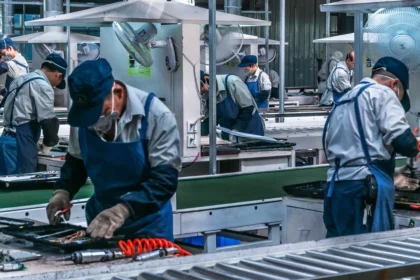



Small Scale Industry are those industries in which start business on a small scale or micro scale as a manufacturing, providing, servicing etc.
Small Scale Industries play an important role in social and economic development of India. They are a very important sector of the economy from a financial and social point of view.
These are generally labour-intensive industries, so they create much employment.
Key Examples and Ventures within the SSI Sector:
- Food Processing: Independent bakeries and artisanal food units.
- Consumer Goods: School stationery manufacturing, leather belts, and small toys.
- Sustainable Packaging: Paper bag manufacturing units.
- Service Enterprises: Photography studios and beauty parlors.
Definition of Small Scale Industry
The definition of small scale industry various from one country to another and from one time to another in the same country depending upon the pattern and stage of development, government policy and administrative set up of the particular country.
At least 50 different definitions of SSIs have been found. In some countries, the criterion for defining small enterprises is related to the size of the employment.
- In USA a small enterprise is one which has employment of 500 people.
- In UK it is less than 20 skilled labours, in Germany, less than 300 and Italy less than 50 people.
The definition of small scale industry is an important aspect of government policy as it identity the target groups.
The first official criterion for small scale industry in India dates back to second five year plan when it was in term of gross investment in land, building, plant, machinery and the strength of the labour force.
Investment Limitation of SSI in India
The financial baseline for identifying SSIs in India has undergone numerous updates since independence to keep pace with inflation and industrial growth:
- In 1950, The fiscal commission for the first time defined as SSI as one which is operated mainly with hired labour usually 10 to 15 hands.
- In 1954-55, The Government of India set up Central Small Scale Industries Organization (CSSIO) and small Industries Board (SSIB) to promote small scale industries.
- In 1960, Employment criterion to define SSI was dropped and under investment criterion an industry having gross value of fixed asset up to Rs. 5 Lakhs was called as SSI.
- In 1975, The Investment limit was rise to Rs. 10 Lakhs (15 Lakhs for ancillary units).
- In 1980, The Investment limit was rise to Rs. 20 Lakhs (25 Lakhs for ancillary units).
- In 1985, The Investment limit was rise to Rs. 35 Lakhs (40 Lakhs for ancillary units).
- In 1995, The Investment limit was rise to Rs. 60 Lakhs (75 Lakhs for ancillary units).
- In March 1997, The Investment limit was raised top Rs. 3 Crore.
- In 1999-2000, The Investment was reduced to 1 Crore.
- In 2007, Limit is 1 Crore only.
Core Characteristics of Small Scale Industries
To understand why SSIs behave differently from large corporations, one must look at their unique operational traits:
- A small unit is generally a one-man show. Even if SSI is run in partnership or company, the activities are carried by one of the partners or directors; the others are as sleeping partners.
- In case of SSI, the owner himself or herself is a manager also ans hence an ssi is managed in a personalized fashion.The owner takes effective participation in all matters of business decision making.
- The scope of operation of SSI is generally localized, catering to the local and regional demands.
- The gestation period i.e., the period after which return on investment starts is relatively lower when compared to large units.
- SSI’s are fairly labour intensive with comparatively smaller capital investment.
- Small units use indigenous resources and therefore, can be located anywhere subject to the availability of these resources like raw materials, labour etc.
- Using local resources small units are decentralized and dispersed to rural areas. Thus small units promote balanced regional development and prevent the influx of job seekers from rural areas to cities.
- Small Scale units are more change Susceptible and highly reactive and receptive to socio-economic conditions.
Objectives of the Small Scale Industry
The various objectives of developing small scale industries are in fact, implied in one way or other, in its rationale itself.
The main objectives of developing small scale enterprised in India.
- To generate immediate and large scale employment opportunities with relatively low investment.
- To eradicate unemployment problem from the country.
- To encourage dispersal of industries to all over country covering small towns, villages and economically lagging regions.
- To bring backward areas too, in the main stream of national development.
- To promote balanced regional development in the whole country.
- To ensure more equitable distribution of national income.
- To encourage effective mobilization of country’s untapped resources.
- To improve the standard of living of people in the country.
The Scope and Market Realities of the Small Scale Industries
The scope of small-scale industries is quite vast covering a owed range of activities. These characterized by labour intensive, need less capital and require less sophisticated technology.
Among them are important activities are :-
- Manufacturing activities
- Servicing/repairing activities
- Retailing activities
- Financial activities
- Whole-sale activities
- Construction activities
- Infrastructural activities like transport, communication etc.
The Government of India has announced a reservation policy for the small sector in the country.
It is also important to note that the performance of reserved small-scale industries does not outshine that of non-reserved small industries.
According to J.C. Sandesara has found that “the easy entry into SSI sector has intensified competition within the sector, and resulted in excess supply, and thus, a fall in profitability.”
Government SSI policy Framework- Latest Amendment
In line with new economic policies, a policy document for SSI was announced on 6th August 1991.
- It continued priority sector lending to SSI by banks/Financial Institutions
- Excise exemption scheme.
- Reservation of items for exclusive production
- Price and purchase preference.
- Uniform package of incentives of the entire sector
It introduced new measures like :
- Removal of location restrictions
- Enhancement of coverage, limits
- Shift towards infrastructural development support
- Inclusion of services in this sector
- Allowing equity investment in SSI
- Shift from protection/regulation to promotion of equality, technology and deficiency
- Substantial deregulation and simplification of rules and procedures.
Final Thoughts
The small-scale industries sector plays a vital role in the growth of the country. These industries are usually started by the lower or middle-class public. They have an opportunity to earn wealth and employee other people. It helps with income distribution and contributes to social progress.
Also Read:-