




Starting a Small scale Industry is a complex job. The potential entrepreneur has to pass through a number of steps in a step-by-step approach to achieve his goal of stetting up an Start Small Scale Industries (SSI).
In fact, Deciding and motivating the self is the first bedrock upon which the establishment concept of an enterprise is entirely posited.
The 24 Steps to Start Small Scale Industries
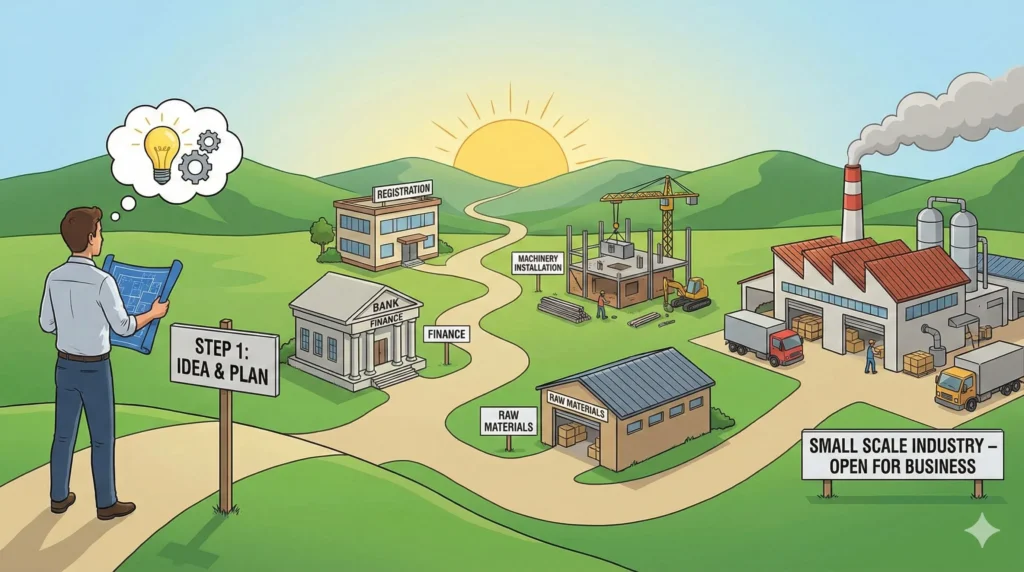
Hence the various steps to start small-scale industries involved in the establishment of an enterprise through which the entrepreneur may pass are the following.
Step 1: Decision to be Self-Employed
This is the most crucial decision a youth has to take, shunning wage employment and opting for self-employment or entrepreneurship to steps to start small scale industries.
Step 2: SWOT Analysis (Strengths, Weaknesses, Opportunities, Threats)
Before investing money, invest time in analyzing yourself. An Potential entrepreneur has to analyze his strengths, weakness, opportunities and Threats, he should must conduct a SWOT analysis:
- Strengths: What are you good at?
- Weaknesses: Where do you lack skills?
- Opportunities: What is the market missing?
- Threats: Who are the competitors?
Step 3: Scanning of Business Environment
It is always essential on the part of the entrepreneur to study and understand the prevailing business environment.
In order to ensure success if his enterprise, entrepreneur should scan the business opportunities and threats in the environment.
And entrepreneur should scan for business opportunities and government policies that support the steps to start small scale industries.
Step 4: Training & Skill Development
Before going to start the enterprise, the potential entrepreneur must assess his own deficiencies which he can compensate through training.
He can avail the facilities of various training institutes like EDI, NIESBUS, IEDs existing in our country.
Step 5: Product Selection
The most important steps to start small-scale industries is to decide what business to venture into, the product or range of products that shell be selected for manufacture and in what quantity.
The level of activity will help in determining the size of the business and thus form of ownership.
Step 6: Market Survey
It is important convenient to manufacture an item but difficult to sell.
Market survey implies systematic collection of data by the entrepreneur about the product for manufacture, demand-supply lag, extent of competition, frequency of demand, pattern and design of demand, its potential share in the marketing pricing, distribution policy etc.
Step 7: From of organization
A firm can be constituted as proprietorship, partnership, limited company, cooperative society, etc. This will depend upon the type, purpose and size of the entrepreneur’s business.
Step 8: Location Selection
The next step will be to decide the location where the unit is to be established. This size of plot, covered and open area and the exact site will have to be decided.
Step 9: Technology Selection
Information on all available technologies should be collected by the entrepreneur and the most suitable one to be identified.
Step 10: Machinery and Equipment
Once the technology is chosen, list the machinery and equipment required for manufacturing the chosen products have to be decided. Compare suppliers for the best rates and warranties.
Step 11: Project Report Preparation
This the most important steps to start small scale industries. After deciding the form of the ownership, location, technology, machinery, and equipment, the entrepreneurs should be ready to prepare his project report the feasibility study.

A project report that may now be prepared will be helpful in formulating the production, marketing, financial and management plans.
Step 12: Project Appraisal
Project appraisal implies the assessment of a project. It is technique for ex-ante analysis of a scheme or project.
While preparing to set up an enterprise, the entrepreneur has to carefully appraise the project form the standpoint of economic, financial, technical, market, managerial and social aspects to arrive at the most socially-feasible enterprise.
The following appraisals can be performed at the preliminary level :-
- Economical appraisal: Is it profitable?
- Financial appraisal: Is the capital sufficient?
- Technical appraisal: Is the technology sound?
- Management appraisal
- Organizational appraisal
- Market appraisal
Step 13: Finance
Finance is the lifeblood of the enterprise. Entrepreneur has to take certain steps and follow specified norms of the financial institutions and banks to obtain it.
Step 14: Provisional Registration
It is always worthwhile to get the unit registered with the government.
The entrepreneur has to obtain the prescribed application from the provisional registration under DIC or Directorate of industries.
This will enable the entrepreneur to avail various government facilities, incentives, and assistance schemes including financial assistance from NSIC/SFCs/KVIC.
Step 15: Technical Know-How
Technical know-how may be arranged for setting up enterprise.
Facilities are also available to SSI for making technical know-how arrangements including turn-key jobs.
Step 16: Power and water connection
The sites, where the enterprise will be located, should either have adequate power connections or this should be arranged.
Entrepreneur can calculate the total power requirement and a water connection will have to be obtained.
Step 17: Installation of Machinery
Having completed the above formalities, the next step is to procure the machinery for installation.
Machinery should preferably be installed as per the plan layout.
Step 18: Recruitment of Manpower
Once machines are installed, the need for manpower arises to run them.
This presupposes the skilled, unskilled and semiskilled labour, administrative staff etc.
Step 19: Procurement of Raw materials
Raw materials are the important ingredients for running an enterprise. The labour will require raw materials to work upon the installed machinery.
Step 20: Production (Trial & Commercial)
The unit established should have an organizational setup. To operate optimally, the organization should employ its manpower, machinery, and methods effectively.
There should not be any wastage of manpower, machinery and materials. Production of the proposed item should be taken up in two stages.
- Trail Production: To test the machinery and tackle initial problems.
- Commercial Production: Commenced after successful test marketing.
Trail production will help tackling problems confronted in production and test marketing of the product. Where Commercial production should be commenced after the test-marketing of the product.
Step 21: Marketing
Marketing is the most important activity as far as the entrepreneurial development is concerned.
Various aspects like how to reach the customer, distribution channels, commission structure, pricing, advertising, publicity etc., have to be decided by the entrepreneur.
Marketing is in two stages namely:
- Test stage
- Commercial marketing stage
Test marketing is necessary to save the enterprise from going into disrepute in case the product launched is not well accepted by the customers.
Commercial marketing can be undertaken. The entrepreneur can contact the small industries marketing cooperation.
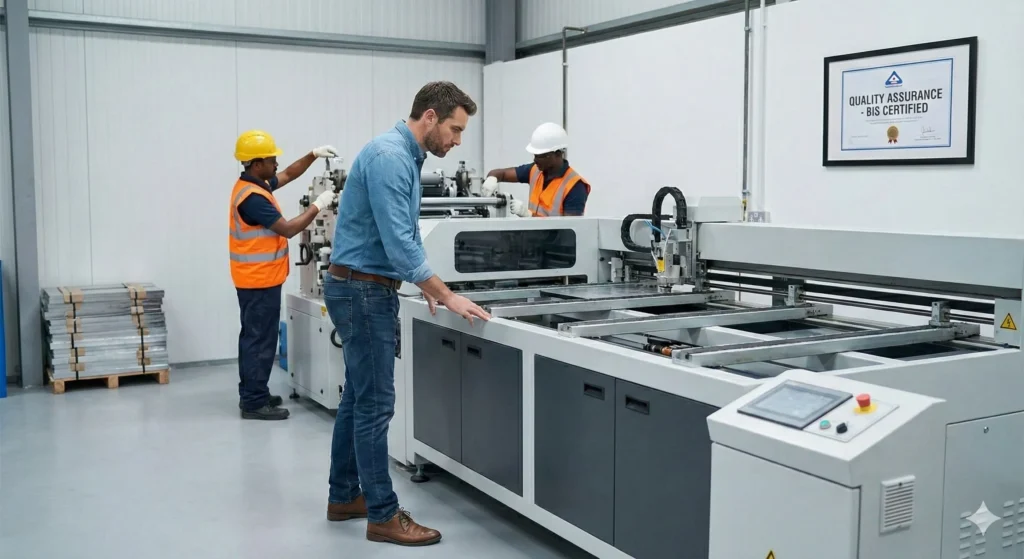
Step 22: Quality assurance
Before marketing, the product quality certification from BIS (Bureau of Indian Standards) or AGMARK/HALLMARK etc.
If there is no quality standards specified for the products, the entrepreneur should evolve his own quality control parameters.
Step 23: Permanent Registration
After the small-scale unit goes into production and marketing, it becomes eligible to get permanent registration based on its provisional registration from DIC.
Step 24: Market Research
There is strong need for continuous market research to assess needs and areas for modification, up-gradation and growth.
Market becomes Waterloos for most SSI entrepreneurs as they ignore the vital day-to-day operation.
These are 24 steps to start small scale industries in anywhere and they are most important factor whose nobody ignores an successful entrepreneurs.
Advantages of Small scale industries
There are many advantages to start a small scale industries
1. Small scale enterprises can be started as per convenience of the owner in terms of space, finance, product, and manpower.
2. The setting up of the unit and starting of production requires a small gestation period of only 2 to 6 months and layout can be made as per convenience.
3. Locally available skilled and semi-skilled people can be appointed at short notice and at a much lower wages compared to the medium and large industries.
4. Wherever high technology involved the parent company executives will help or consultants can be hired to sort out technology related problems.
5. It is one of the best forms of self-employment as well as giving employment opportunities to own kith and kim, friends and relatives etc.
In case of rural sector the SSI units will be able to have cheaper labour especially in off seasons.
6. SSI units not only contribute to the development of economy of the nation but also create employment opportunities to people around the project sites.
7. In case of SSI units started by experienced and talented executives, there is abundant scope to develop high technology components for MNCs and also to organize exports.
8. Due to increase in population there has been increase in production of consumer goods and fast moving consumer goods in local area.
9. The small units are exempted from excise duty up to 75 Lakhs per annual turnover. Thus lot of paper work and formalities are avoided in taxes.
10. Since employees are recruited based on contacts or relations there will be loyalty to the owner and hence there will be no trade union activity.
At last words, Small scale industries is plays important role for economic development in country and For a middle-class family wanting to start their own business, following these 24 steps to start small scale industries is the best roadmap to success.
If you have any questions about starting your Steps to Start Small Scale Industries (SSI) unit, feel free to comment below!
Frequently Asked Questions (FAQs)
Q1: What is the first step to start a small scale industry? The first step is the decision to be self-employed. Before investing money, you need to conduct a SWOT analysis to understand your personal strengths, weaknesses, and the opportunities available in the market.
Q2: Why is a Project Report important for SSI? A Project Report is like a roadmap for your business. It is essential for obtaining bank loans because it tells the bank that your plan is financially viable. It also helps you plan the technical and management aspects of the business